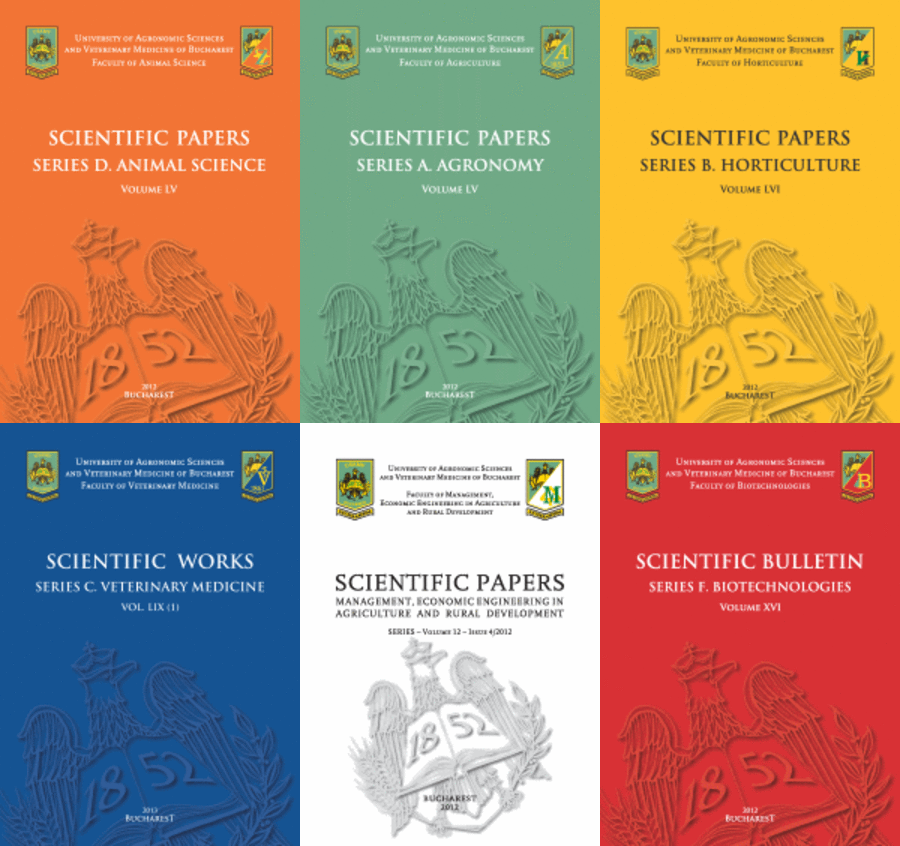
ISSN 2285-6064, ISSN CD-ROM 2285-6072, ISSN-L 2285-6064, Online ISSN 2393-5138
 

Published in Scientific Papers. Series E. Land Reclamation, Earth Observation & Surveying, Environmental Engineering, Vol. XIV
Written by Senad MURTIĆ, Adnan HADŽIĆ

The phenomenon of global climate change, largely driven by human activities and associated with rising air temperatures, not only leads to intensified and longer-lasting droughts, but also increases the likelihood of extreme precipitation events that may trigger flooding concerns. The stress caused by soil waterlogging is intricate, leading to several concurrent challenges that disrupt normal plant functioning. A key challenge is the oxygen deficiency, which arises from the considerably reduced diffusion rates in floodwater relative to those in the atmosphere. The ability of plants to adapt to waterlogging stress is quite limited primarily because of the partial or complete absence of oxygen in the growth medium. However, certain plant species have evolved specific mechanisms through evolution that allow them to survive for a certain duration in hypoxic or anoxic environments. These mechanisms can be classified into two broad categories: plant morpho-anatomical adaptations to waterlogging stress and the biochemical and physiological responses of plants to such stress. These adaptations are interconnected rather than acting in isolation. Instead, they are intricately connected. This review explores: (i) the impact of soil waterlogging on plant development and function; (ii) current insights into the signal transduction pathways involved in stress recognition and response; and (iii) the key morpho-anatomical and physiological strategies plants use to cope with waterlogged conditions.

[Read full article] [Citation]

Published in Scientific Papers. Series E. Land Reclamation, Earth Observation & Surveying, Environmental Engineering, Vol. XIV
Written by Timea GABOR, Andreea HEGYI, Stelian COSTE, Alina Iuliana CADAR, Cristian PETCU, Carmen FLOREAN, Ioana Monica SUR

Agricultural activities generate substantial volumes of waste and by-products annually, primarily of plant origin, which are either underutilized or not utilized at all. Through partial pyrolysis, these waste materials can be transformed into a product known as "biochar (BCH)," which has potential applications in both agriculture and innovative construction materials. This paper presents a comparative study examining the impact of BCH utilization in these two fields. Research findings demonstrated beneficial effects on soil quality and crop yield improvement. Additionally, studies conducted on cementitious composites incorporating 5-15% biochar revealed reduced density, increased open porosity, maintained mechanical strength parameters, and thermal conductivity values that suggest the possibility of developing innovative mortars with enhanced thermal resistance or suitable for manufacturing paving elements. Through this dual approach, this paper aims to highlight the potential of transforming agricultural waste into valuable materials that benefit both agriculture and the development of new, innovative, and environmentally friendly construction materials.

[Read full article] [Citation]

Published in Scientific Papers. Series E. Land Reclamation, Earth Observation & Surveying, Environmental Engineering, Vol. XIV
Written by Andreea HEGYI, Cristian PETCU, Claudiu Sorin DRAGOMIR, Gabriela CĂLĂTAN, Alexandra CSAPAI

One of the key challenges associated with traditional buildings constructed from vernacular materials is their response to climatic agents and microorganisms. These present a significant challenge also for the surface of constructions based on unbaked clay elements. This paper presents the possibility of creating plasters based on clay, lime and other additives, their behaviour in response to mould growth, and the potential for coating treatments to enhance their resistance to the harmful action of microorganisms. The antifungal treatment was conducted with the objective of exploring the potential for recycling expired non-food household and medical products. The experimental results indicated the initial development of colonies of Penicillium notatum and Aspergillus niger and subsequently demonstrated the potential for enhancing resistance to mould action through pellicular treatment and/or surface impregnation. It can therefore be concluded that not only is it possible to create clay-based plasters with enhanced performance, but also that this represents an original contribution to the implementation of the concept of the circular economy.

[Read full article] [Citation]

Published in Scientific Papers. Series E. Land Reclamation, Earth Observation & Surveying, Environmental Engineering, Vol. XIV
Written by Sorin ȘTEFĂNUȚ, Miruna-Maria ȘTEFĂNUȚ, Tiberiu SAHLEAN, Ana-Maria MOROȘANU, Florența-Elena HELEPCIUC, Georgiana-Roxana NICOARĂ, Constantin-Ciprian BÎRSAN, Gabriel-Mihai MARIA, Mihnea VLADIMIRESCU, Anca MANOLE, Constanța-Mihaela ION

Peatland habitats are well-known for their function in sequestering carbon, characterized by peat-forming species such as Sphagnum mosses. The Avrig peat bog, located at the foothills of the Făgăraș Mountains in the Olt River basin, is a small site (less than 4 hectares) proposed for designation as a Natura 2000 site. A eutrophic palustrine zone encircles the peat bog's center oligotrophic zone, dominated by Sphagnum mosses. This area is characterized by the presence of the European-protected priority habitat Active raised bogs (habitat code 7110). We employed a combination of field surveys and aerial investigations to assess the site's biodiversity and evaluate potential threats. The collected Sphagnum samples were morphologically examined in the laboratory, revealing several species, like Sphagnum medium Limpr., Sphagnum capillifolium (Ehrh.) Hedw. and Sphagnum girgensohnii Russow. The bog also supports rare plant and amphibian species of conservation interest. Targeted management strategies are necessary to mitigate pressures including agricultural runoff, drainage, invasive species, and peat extraction.

[Read full article] [Citation]

Published in Scientific Papers. Series E. Land Reclamation, Earth Observation & Surveying, Environmental Engineering, Vol. XIV
Written by Cornelia BAERĂ, Aurelian GRUIN, Ana-Cristina VASILE, Bogdan BOLBOREA, Alexandru ION, Luiza VARGA, Alexandra Marina BARBU

Waterjet cutting is an industrial method that uses high-pressure water jets to cut a variety of materials such as metals, concrete, wood, ceramic, stone, rubber, foams, plastic, etc. For improving the procedure performance, in terms of speed and cutting accuracy, abrasive agents like red garnet sand is mixed with the water, generating the Abrasive Water Jet (AWJ) methodology. This is known to present environmental drawbacks, including the production of wastewater, garnet sludge and corresponding dried wastes, and microscopic particles from the cut materials, still disposed in household landfills, which generate severe environmental issues. Using Garnet Sand (SG) wastes in cementitious materials (mortars and concrete) as partial aggregate substitution is an innovative approach to enhance sustainability in construction, offering several benefits like increased strength, durability performance, etc., reduced production costs due to the re-using material approach and ecological protection as well. Preliminary studies in this direction were conducted in the last years within NIRD URBAN – INCERC, Timişoara branch, showing encouraging results in the proposed aggregate substitution proposal in the regular mortar mixes, in accordance with initial international studies in the field. The current paper aims to confirm the initial results by specific extension of the research area, reaching some critical parameters, like SG material source variation, as a mandatory validation procedure of preliminary conclusion and foundation of further specific studies regarding the viability of the SGs recycling opportunities in construction products and their effective use.

[Read full article] [Citation]

Published in Scientific Papers. Series E. Land Reclamation, Earth Observation & Surveying, Environmental Engineering, Vol. XIV
Written by Sally SALEHI, Farid Gholamreza FAHIMI, Masoud Kia DALIRI, Ahmad TAVANA, Keyvan SAEB

Recycling construction soil and debris is a key strategy for reducing pollution and enhancing economic efficiency. The process of sand production from construction debris, while beneficial, results in the accumulation of dense sludge containing harmful elements in sand-washing machines like EvoWash. This study investigates the potential reuse of mineral-rich sludge from the EvoWash machine for cultivating non-fruit-bearing plants, addressing environmental concerns at the Aabali landfill in Tehran. Eight plant species were selected: Nerium, Spruce, Rose, Eucalyptus, Bitter Olive, Myrtle, Ornamental Pistachio, and Cactus, chosen for their compatibility with the heavy metal content in the sludge and their native presence in Tehran, facilitating reuse without extensive transportation. Comprehensive laboratory analyses identified essential mineral elements in the sludge, indicating its potential for plant growth. Bi-weekly monitoring of plant growth over four months showed that a mixture of sludge and garden soil significantly improved plant development compared to pure sludge or garden soil alone. While certain plants struggled in 100% sludge, the mixed medium yielded superior growth outcomes. The study provides insights into the feasibility of using EvoWash sludge for sustainable plant cultivation, presenting a promising solution for reusing construction debris sludge and aligning with eco-friendly waste management practices. The findings highlight the potential of EvoWash sludge in enhancing soil fertility and supporting plant growth, contributing to sustainable agricultural practices and environmental conservation.

[Read full article] [Citation]

Published in Scientific Papers. Series E. Land Reclamation, Earth Observation & Surveying, Environmental Engineering, Vol. XIV
Written by Anca MANOLE, Ana-Maria MOROȘANU, Attila MÁTIS, Anna SZABÓ, Georgiana-Roxana NICOARĂ, Florența-Elena HELEPCIUC, Mihnea VLADIMIRESCU, Ioana Cătălina PAICA, Mihaela CIOBOTĂ, Daniela Elena MOGÎLDEA, Constantin-Ciprian BÎRSAN, Constanța-Mihaela ION, Tiberiu SAHLEAN, Sorin ȘTEFĂNUȚ

The Stupini mire, proposed as a new Natura 2000 site, is a wetland located in Romania's Bârsa Depression. The site hosts a diverse range of habitats, including alkaline fens (7230), calcareous fens (7210*), Molinia meadows (6410), hygrophilous tall herb communities (6430), and alluvial forests (91E0*). This study highlights the ecological importance of the mire and evaluates the impact of recent restoration efforts. Vegetation surveys conducted between 2022 and 2024 confirmed the presence of rare and protected species, such as Swertia perennis and Primula farinose as well as the glacial relict Ligularia sibirica, a species protected under European legislation. However, the rare orchid Liparis loeselii was not detected, raising concerns about its possible local extinction due to drought and habitat degradation. To counteract these threats, restoration efforts focused on reestablishing the hydrological balance and removing invasive species. These measures resulted in a notable increase in the water table, with levels rising by up to 10 cm. The findings underscore the urgency of continued conservation efforts and formal designation of the site under Natura 2000 to prevent further biodiversity loss.

[Read full article] [Citation]

Published in Scientific Papers. Series E. Land Reclamation, Earth Observation & Surveying, Environmental Engineering, Vol. XIV
Written by Lucian Sorin DOROG

This study investigates how different stand structures influence vulnerability to windthrows, using the vertical differentiation index as an analytical tool. Measurements were conducted in three forest districts containing stands with varying structures: even-aged, relatively even-aged, relatively uneven-aged, and uneven-aged. Findings indicate that the vertical differentiation index has subunit values close to zero in even-aged stands and approaches one in uneven-aged stands. A significant inverse correlation was observed between this index and the percentage of wood affected by windthrows. These results underscore the importance of diversifying stand structures in Romanian forest management to mitigate ecological and economic losses.

[Read full article] [Citation]

Published in Scientific Papers. Series E. Land Reclamation, Earth Observation & Surveying, Environmental Engineering, Vol. XIV
Written by Catalin-Stefanel SABOU, Simion BRUMA, Ioana POP, Florica MATEI, Paul SESTRAS, Jutka DEAK, Silvia CHIOREAN, Tudor SALAGEAN

The evaluation of river course variations, such as bank erosion, sediment deposition, and the influence of nearby human-made structures, is facilitated by the use of remote sensing data and topographic analysis. These changes result from natural events, such as floods, as well as human activities, including the removal of fertile soil, sand extraction, and deforestation. This study highlights the impacts of these changes on river corridor ecosystems, as well as on the infrastructure and properties located along the watercourse. Continuous changes to the Earth's surface are driven by both natural and artificial factors, which contribute to the erosion, transport, and accumulation of sediments. Among geomorphological agents, flowing water exhibits a particularly high erosive capacity. A primary objective of this study is to identify these changes, with a secondary focus on providing an overview of the current state of river corridors and bank erosion. To achieve this, the research utilizes remote sensing (RS) techniques and geographic information systems (GIS), along topographic data, to effectively monitor and analyze these transformations.

[Read full article] [Citation]

Published in Scientific Papers. Series E. Land Reclamation, Earth Observation & Surveying, Environmental Engineering, Vol. XIV
Written by Ioan ROTAR, Florin PĂCURAR, Marcel DÎRJA, Anca PLEȘA, Alina ȘUTEU, Ioana GHEȚE, Ferencz VAKAR

Grasslands are among the most widespread terrestrial ecosystems, covering over one-third of the Earth's surface. They play a pivotal role in carbon sequestration and the accumulation of soil organic matter (SOM), processes essential for soil fertility, biodiversity conservation, and climate regulation. The degradation and conversion of grasslands into croplands have historically contributed to significant soil organic carbon (SOC) losses, intensifying global warming. This hypothetical research paper proposes a comparative analysis of SOM dynamics between grasslands and arable lands worldwide. A standardized experimental design is outlined, involving soil sampling at two depths (0-20 cm and 20-40 cm), across three land-use types (natural grassland, degraded grassland, and arable land). Hypothetical results, based on existing literature, indicate that grassland soils retain 30-50% more SOM than arable soils, particularly in the upper soil layers. Findings emphasize the necessity of protecting grasslands through sustainable management practices such as controlled grazing, overseeding, and restoration programs. Global policies must prioritize grassland conservation to achieve soil health, food security, and climate change mitigation objectives.

[Read full article] [Citation]

The publisher is not responsible for the opinions published in the Volume. They represent the authors’ point of view.

© 2019 SCIENTIFIC PAPERS LAND RECLAMATION, EARTH OBSERVATION & SURVEYING, ENVIRONMENTAL ENGINEERING. All Rights Reserved. To be cited: SCIENTIFIC PAPERS LAND RECLAMATION, EARTH OBSERVATION & SURVEYING, ENVIRONMENTAL ENGINEERING.

Powered by INTELIDEV